
We're all getting a little bored with heart-rate monitors and screenless fitness trackers. Luckily, innovations like Alveos still make consumer health tech a dynamic and interesting space to follow.
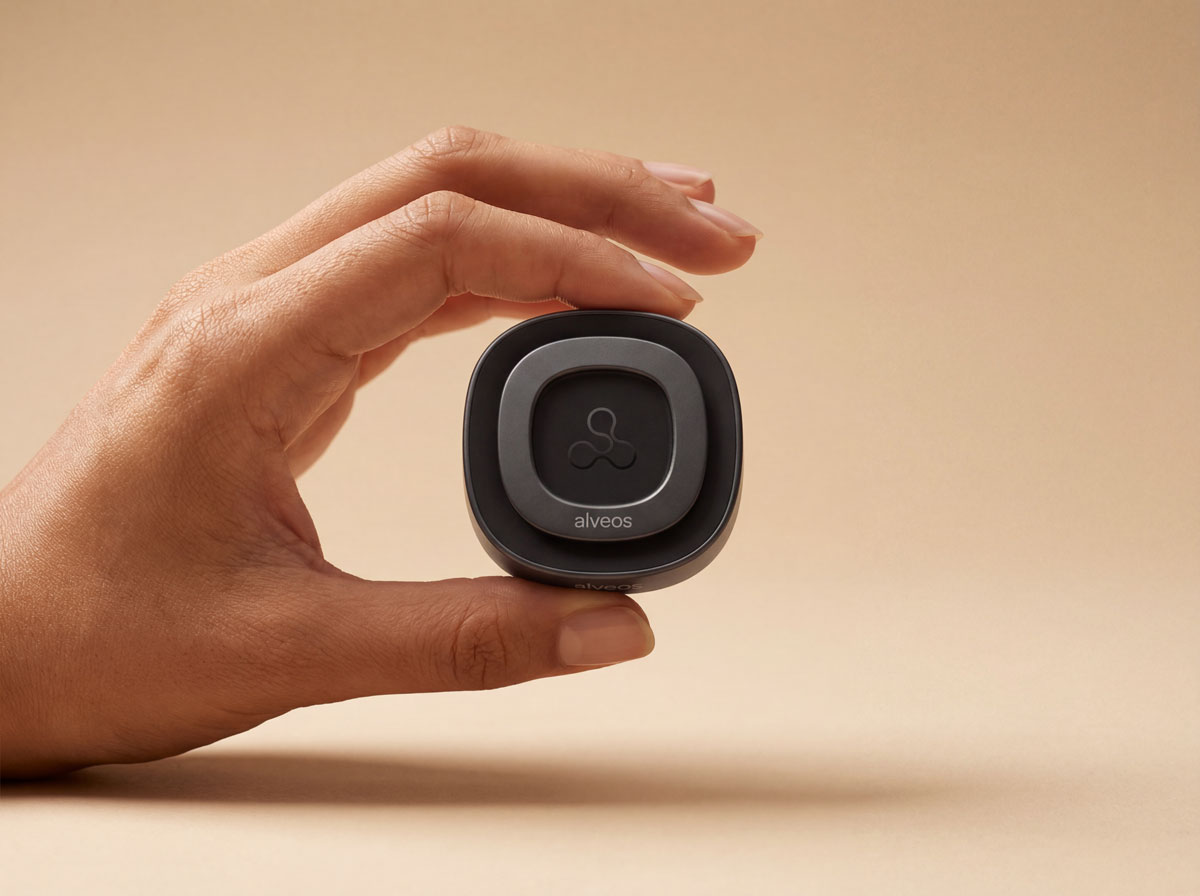
Patrick Obolgogiani and his team are developing Alveos One, a chest-worn wearable that measures breathing and heart sounds. But instead of overwhelming users with another set of stats and metrics, Alveos is building its product into a closed-loop experience.
Through subtle haptic cues, the wearable helps users become aware of changes in their breathing patterns. Alveos’ companion app then guides users through exercises, responding in real time to breathing changes.
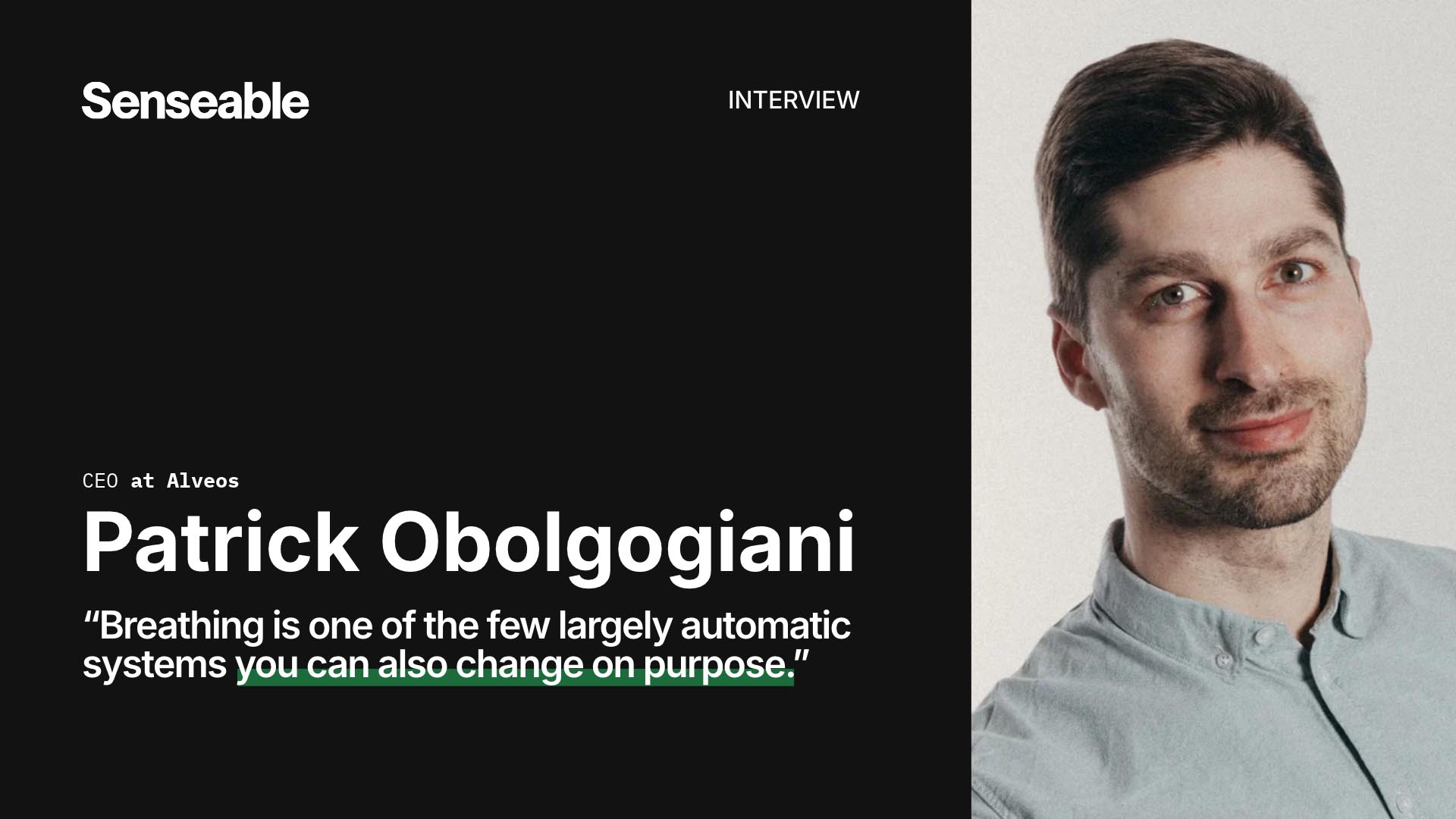
We spoke with Patrick, Alveos' co-founder and CEO, about the upcoming launch of Alveos One, the science behind breathing, and the challenge of building a wearable that helps people actively regulate their physiological state.
What does Alveos One measure?
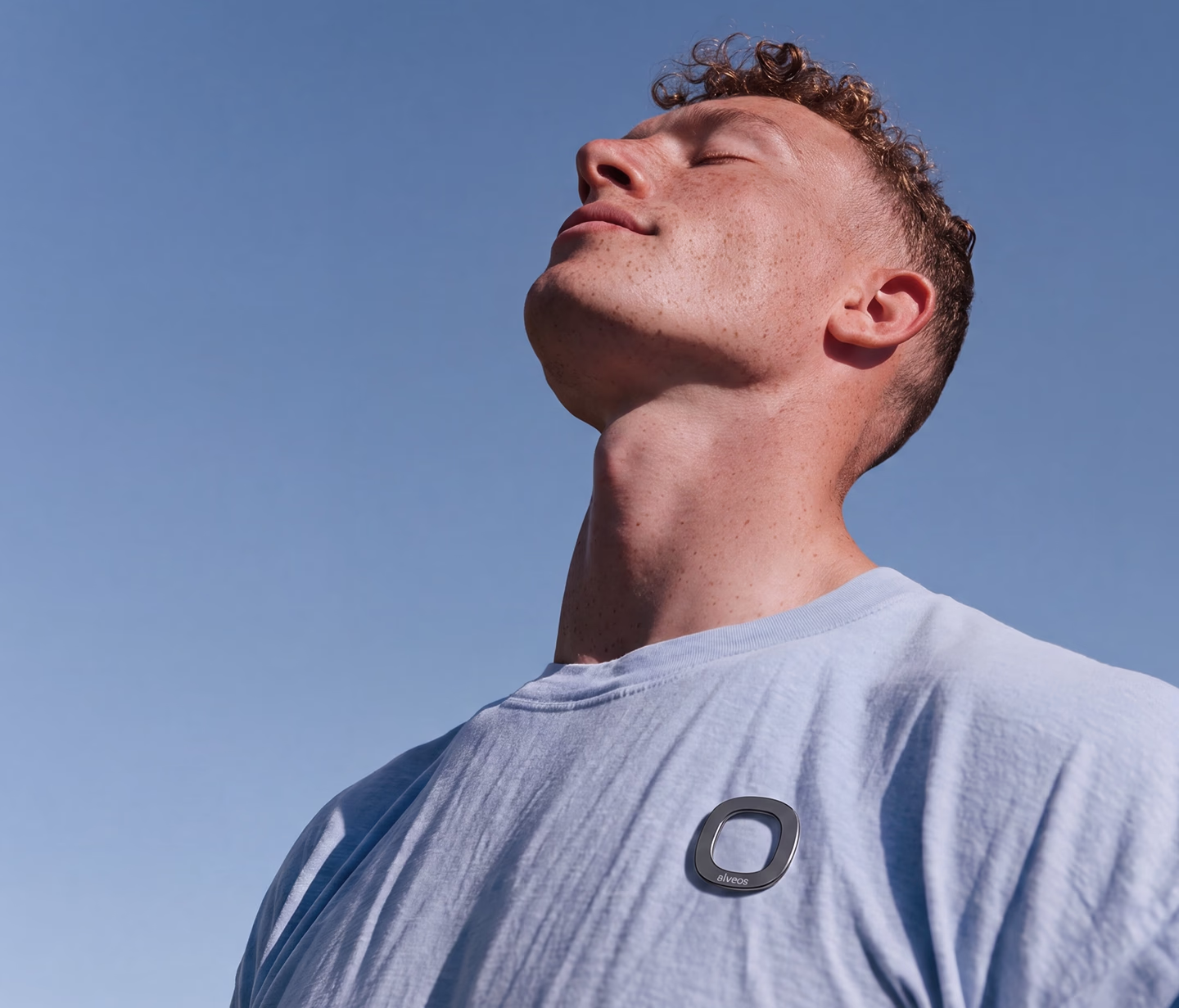
Alveos One sits on the upper chest, over the sternum, held in place by a magnet through your shirt. Inside, we use a mechano-acoustic sensor that picks up chest-wall and airflow vibrations, alongside a motion sensor (IMU).
By filtering these signals, we can separate breathing activity from heart sounds. From a single location, we capture the breathing waveform and individual heartbeats. Our software then assesses signal quality, discards unreliable measurements, and calculates breathing rate and timing. Heart sounds provide heart rate and heart rate variability (HRV), while the motion sensor helps us account for movement and changes in posture.
The processing happens across three layers. The device handles real-time decisions, such as when to give a haptic nudge. The phone provides live insights and guided routines, while our cloud backend handles deeper analysis and maintains personal baselines.
And importantly, the sensor doesn't capture the frequencies needed to record speech, so it can't listen to your conversations.
What can breathing measurements reveal that a watch or ring typically misses?
Rings and watches generally estimate breathing rate indirectly, using pulse signals or motion, and are most useful for overnight averages. We measure the breathing waveform directly, throughout the day, even as you talk, change posture, or exercise.
This gives us breath-by-breath detail, including variations in breathing rhythm, sighs, and how your heart rate rises and falls with each breath. That last phenomenon, known as respiratory sinus arrhythmia, provides a window into cardiac vagal activity.
The other difference is that breathing is something you can actively influence. While rings and watches primarily track and report, breathing is one of the few largely automatic processes we can consciously control. The same signal can reveal a physiological shift and then show whether taking a few slower breaths made a difference.
Which metrics and insights will users have access to at launch?
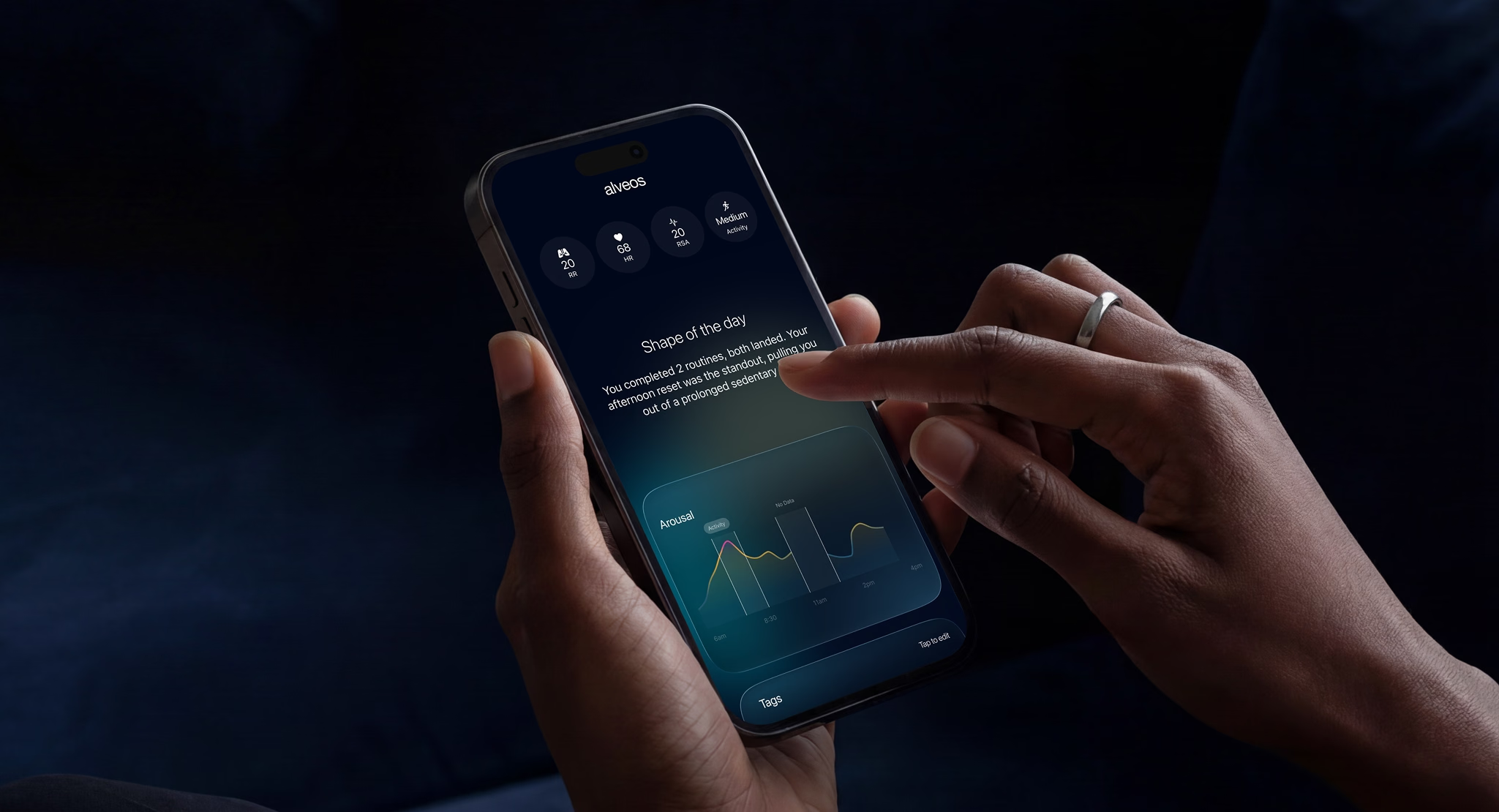
At launch, we're focusing on rest and light activity, with sleep and exercise tracking coming later. Alongside a live breathing waveform, the app provides six metrics: respiratory rate, inhale-to-exhale ratio (I), heart rate, systolic time interval (the timing of each heartbeat derived from heart sounds), respiratory sinus arrhythmia (RSA), and heart rate variability (HRV).
These feed into our Activation Index, which estimates physiological activation during rest based on your personal baseline. We pair this with a quick mood check-in, because breathing can tell us how activated someone is, but not whether that feels good or bad. Guided breathing routines with haptic pacing are also available from day one.
Looking ahead, we're working on metrics such as respiratory rate variability, sigh frequency, deviations from baseline breathing, and recovery after exercise. We're also exploring the detection of sounds like laughter, coughing, and wheezing. Each feature will be introduced once we're confident it performs reliably outside the lab.
How does Alveos decide when to prompt users, and how do its haptics guide breathing?
At launch, the haptic nudges run directly on the device, so they work without your phone nearby. By default, they're guided by the Activation Index, which looks at biomarkers like RSA and inhale-to-exhale ratio while you're at rest.
The device doesn't respond to a single reading. It waits for a sustained shift from your personal baseline and only acts when the signal quality is reliable. That means no nudges while you're moving around or recovering from a run.
When a shift is detected, the device gives you a gentle tap and offers a breathing routine. The same haptics then guide your inhales and exhales, allowing you to follow along without looking at a screen.
How much can Alveos infer about stress, focus, fatigue, or recovery from breathing and cardiac signals?
Less than this category usually claims, and we'd rather be upfront about that.
Breathing and cardiac signals are useful for measuring physiological activation, essentially how revved up or settled your body is. But they're much less informative about whether that state feels positive or negative. Faster, less regular breathing could reflect a tense meeting or a great conversation. In everyday life, posture, speech, and movement can also influence breathing more than mood does.
That's why we measure activation and ask users how they're feeling, allowing the two to build a more personal picture over time.
We don't currently offer focus or fatigue scores, and we make no medical claims about stress or anxiety. We are exploring recovery after exercise, particularly how quickly breathing returns to baseline.
What did the University of Kent validation study reveal, and what are you looking to validate next?
Professor John Dickinson's lab at the University of Kent tested Alveos One against laboratory references, including structured light plethysmography and breath-by-breath spirometry. The study involved 20 healthy adults across rest, paced breathing, posture changes, speech, and treadmill exercise.
Respiratory rate was within 2 breaths per minute of the reference measurements in 94.6% of readings at rest and 79.3% during exercise.
What surprised us most was that our magnetic, through-clothing attachment matched the performance of an adhesive patch at rest and performed better during exercise.
We also learned where the technology struggles, particularly during heavy movement, abrupt changes in breathing, and speech, which is best treated as a separate state.
The limitations are important. This is a June 2026 bioRxiv preprint, not yet peer-reviewed, based on a single lab session with healthy adults. Only respiratory rate was validated.
Next, we want to study multi-day, real-world use, including comfort, placement consistency, different garments, and body types. Beyond measurement accuracy, we also want to validate whether our haptic nudges actually help people regulate their breathing.
Do you see Alveos as a standalone wearable, or eventually part of a broader health-tracking ecosystem?
At launch, Alveos will be a standalone device with its own companion app, which can also read data from Apple Health.
Longer term, we see continuous breathing data as something other platforms and services can build on. That could include coaches and practitioners working with clients, or integrations with tools people already use.
It's still early, so we don't have firm dates yet. However, we're aiming to make a robust API and Model Context Protocol (MCP) integration available close to launch.