
.svg)
.svg)

.svg)
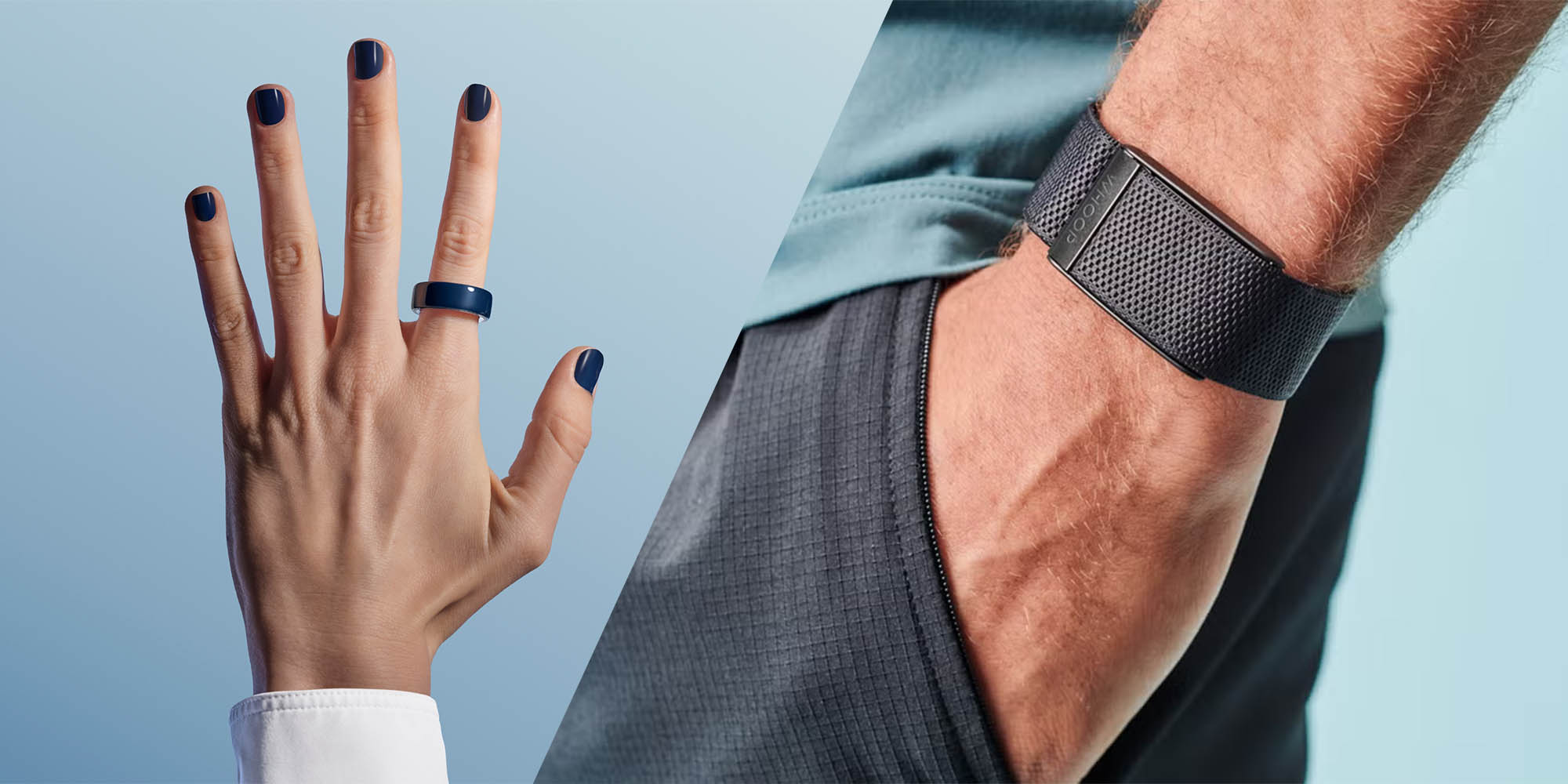

WHOOP and Oura already tell us about stress, recovery, sleep, and readiness. As their sensors improve and health ambitions expand, cognition and mental state look like obvious next targets.
That does not necessarily mean either company needs to start measuring the brain directly.
The more likely route is already taking shape. WHOOP and Oura can combine heart rate, HRV, temperature, sleep, activity, and other physiological signals with increasingly capable models to infer what may be happening further upstream.
Oura is extracting more from the ring
Oura has steadily expanded beyond sleep and recovery into stress, resilience, cardiovascular health, and women’s health. Most of those features rely on variations of the same core sensor stack.
Its stress features are a useful example. Daytime Stress and Resilience use signals including HRV, heart rate, temperature, and movement to estimate how the body is responding to strain. These measurements do not reveal neural activity, but capture downstream physiological changes associated with stress.
The company is also putting more emphasis on interpretation. Oura Advisor combines biometric data with user inputs to provide personalized guidance, while newer proprietary models are being built around specific health areas.
Oura has even started studying cognition directly. A 2026 study with Cambridge Cognition is pairing cognitive assessments from as many as 45,000 members with continuous ring data. The study directly tests whether changes in sleep, stress, and physiology can reliably predict changes in memory, attention, and reaction time.
If those relationships are strong enough, adding direct brain measuring hardware may offer less incremental value than expected.
WHOOP is following a similar path
WHOOP is also broadening the type of health information it derives from the wrist.
Its 5.0 generation expanded into cardiovascular health, ECG, blood pressure insights, and Healthspan, while the company has increasingly talked about predictive health models alongside performance and recovery.
Mental health provides an early indication of where this could go. In a study involving more than 170,000 WHOOP members, researchers compared more than 300,000 validated mental-health surveys with roughly 7.9 million days of wearable data.
Higher HRV, lower resting heart rate, more consistent sleep, and physical activity were associated with lower self-reported stress, anxiety, and depression.
Those signals cannot diagnose someone's mental state. They can, however, give WHOOP enough information to recognize patterns associated with how users are feeling, particularly when combined across long periods of personal data.
That is a much easier product path than adding a completely new brain-sensing device.
Would EEG actually make sense?
Direct brain measurement would require a different form factor.
EEG needs electrodes positioned around the head or ears with reliable skin contact. That works for sleep headbands, earbuds, and specialist devices, but it conflicts with one of the strongest qualities of WHOOP and Oura. Both products are passive enough to wear almost continuously.
Adding a head-worn product also creates another device to charge, another habit to maintain, and another dataset to integrate. For most existing WHOOP and Oura use cases, the extra signal would need to deliver a clear improvement over what their current sensors can already infer.
That threshold keeps rising as the models improve.
There are situations where direct neural sensing could add something genuinely new, particularly regarding sleep staging, attention, fatigue, and some cognitive measurements. Ear-based EEG may eventually make those capabilities easier to integrate into everyday products.
For WHOOP and Oura specifically, though, there is little evidence that either is preparing to move there soon.
The brain without a brain sensor
The more interesting development may be how far wearables can move toward brain-related insights without measuring neural activity at all.
Years of continuous personal data give WHOOP and Oura a strong baseline for detecting subtle deviations in physiology. Add cognitive assessments, self-reported mental states, lab results, and increasingly capable machine-learning models, and those signals can become useful inputs for estimating stress, mood, fatigue, and cognitive performance.
That will not turn a ring or wrist strap into an EEG device. It may make direct brain sensing unnecessary for many of the consumer insights people actually want.
For the deeper look at both companies' research, acquisitions, and product strategies, read the full Neurofounders piece.


.svg)

.jpg)