
.svg)
.svg)

.svg)
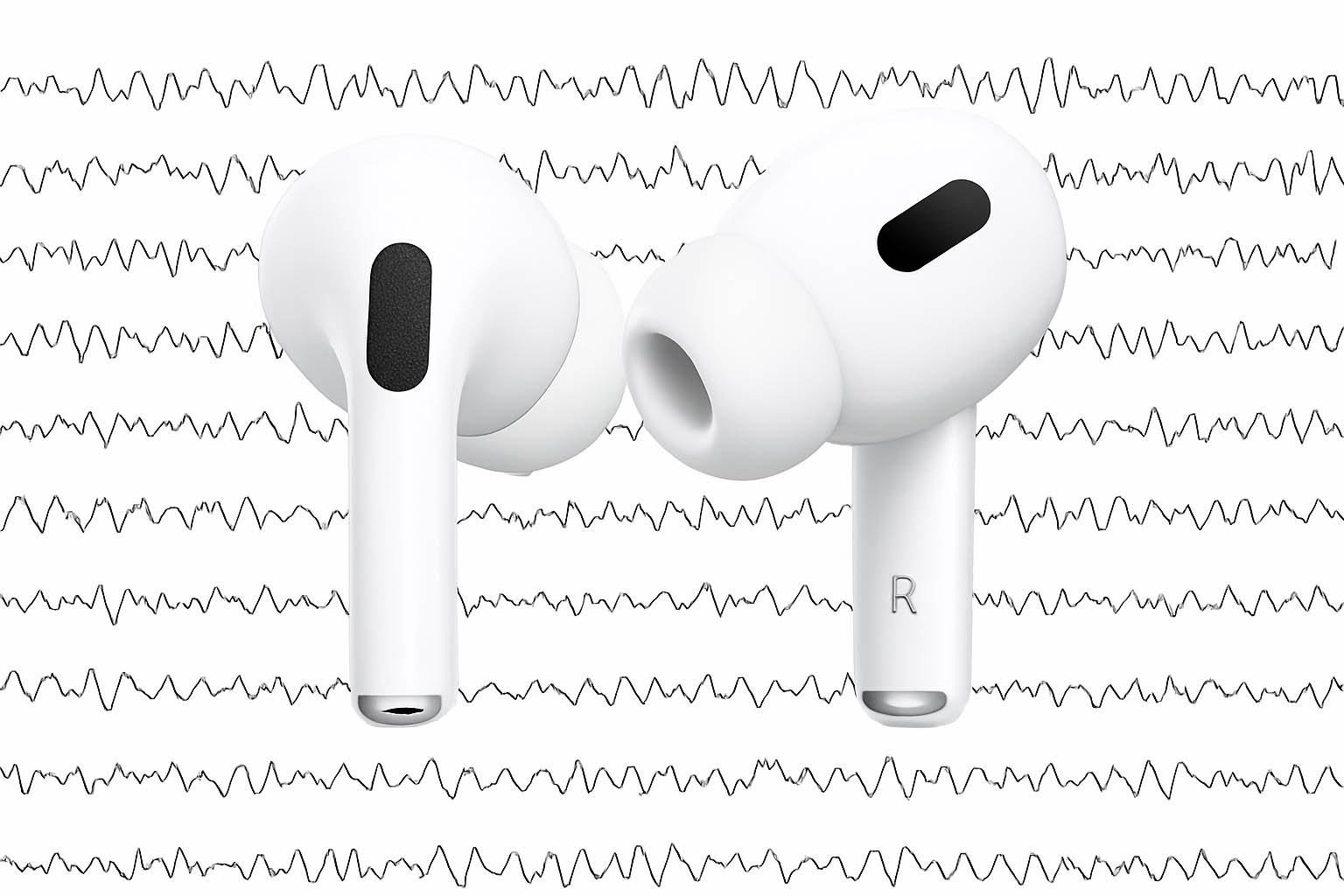

Apple has already designed a version of AirPods that can read electrical signals from the brain. Whether it ever reaches Apple Stores is another question.
A 2023 Apple patent describes earbuds with electrodes positioned across the tip, housing, and stem. The system could dynamically select the contacts producing the cleanest signal and potentially record EEG, EMG, EOG, cardiac activity, and skin conductance.
The hardware remains a patent, but the underlying idea is becoming fairly realistic.
EEG is moving into the ear
EEG traditionally requires electrodes placed across the scalp. The ear offers a more consumer-friendly location, with relatively stable skin contact and a form factor people already wear for hours.
Several companies are already testing the approach. NextSense has launched wireless Smartbuds with in-ear EEG for sleep tracking, while Neurable sells headphones that use neural signals to estimate focus. IDUN is developing an ear-EEG platform for researchers and developers.
These products suggest that recording usable EEG from consumer audio hardware is possible. But these startups do not operate at the scale of Apple, which needs the tech to be reliable enough for hundreds of millions of AirPods users.
Ear anatomy varies, earbuds shift during use, and electrical signals measured through the skin are weak and easily contaminated by movement and muscle activity. Apple's patent attempts to address this by automatically testing different electrode combinations for each user.
What would EEG add?
Sleep is one of the clearest applications. Direct neural signals could improve sleep staging compared with the heart rate and movement data currently used by most consumer wearables.
During the day, AirPods could potentially estimate states such as attention, fatigue, or cognitive load. Apple could feed those signals into Apple Health, adaptive audio, Focus modes, or other parts of its device ecosystem.
When could it happen?
There is no public indication that EEG is coming to the next generation of AirPods.
Apple patents many technologies that never become products, and brain sensing introduces extra problems around battery life, fit, privacy, and regulation. Any EEG feature would also need to provide enough value to justify making AirPods more complicated.
Startups such as NextSense are effectively testing that proposition now. If ear-EEG proves useful for sleep or everyday cognitive tracking without compromising comfort, Apple has both the technical groundwork and the distribution to bring it into the mainstream.
That makes EEG AirPods plausible this decade, but there is little reason to expect them imminently.
For the deeper look at Apple's patent, competing products, and possible use cases, read the full Neurofounders piece.


.svg)

.jpg)