
Korean health-tech startup Apollon has raised around $3.8 million in Series A funding to develop Moglu, a wearable designed to continuously measure glucose without inserting a needle. SBI Investment led the round, with Naver and Daewoong among the strategic investors.
Founded in 2021, Apollon has collaborated with MIT’s Laser Biomedical Research Center since 2023. The new $3.8 million (₩5 billion) round will support further miniaturisation of its approach, clinical testing, and a US regulatory pathway.
Reading glucose with light
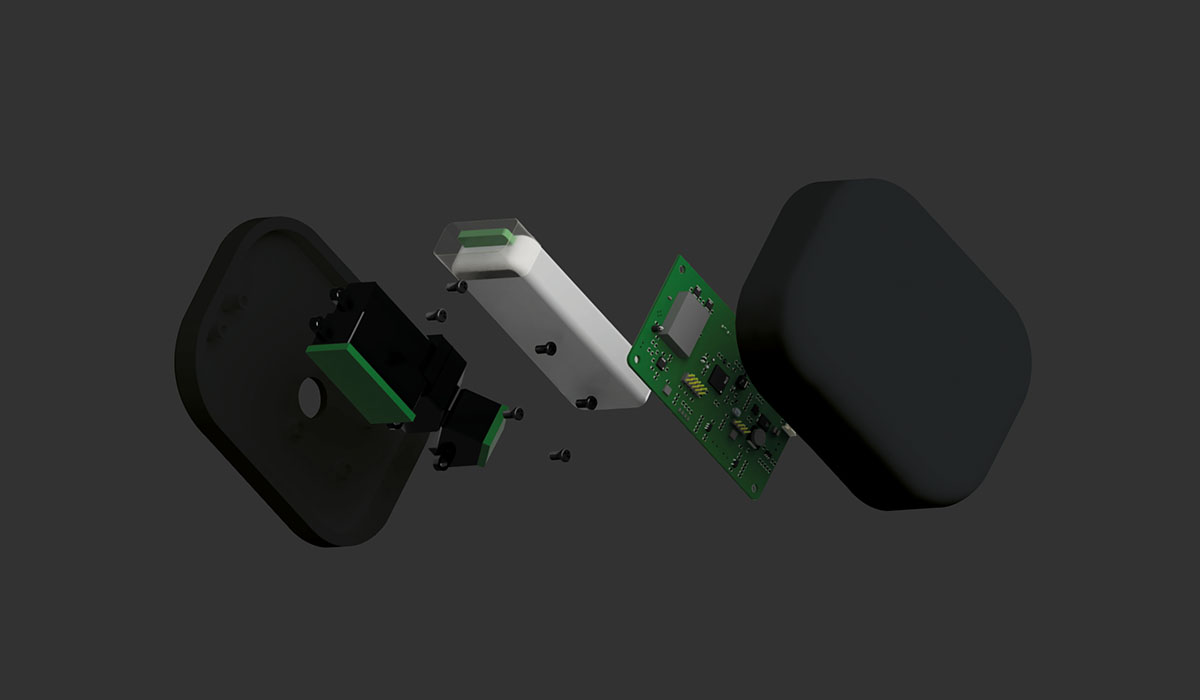
Moglu uses a technique called Raman spectroscopy. The device shines near-infrared light into the skin and analyses how molecules scatter that light. Different molecules produce distinct patterns, allowing the system to look for a molecular fingerprint associated with glucose.
Traditional Raman systems collect a broad spectrum of scattered light and require relatively bulky optical equipment. Apollon instead measures narrow wavelengths associated with glucose, which the company says allows it to shrink the hardware towards a wearable.
An early feasibility study, published this year, tested a bulkier version of the system in six healthy adults. It reported 11.34% MARD, a common measure of glucose-monitor accuracy, compared with 10.42% for Abbott’s FreeStyle Libre 3 and 12.93% for Dexcom G7.
The study consisted of a small sample, featured larger/heavier technology, and relied on participant-specific calibration. Still, it provides early human validation for the sensing approach.
Chasing a much larger CGM market
Apollon's market opportunity extends well beyond replacing one glucose sensor. Around 589 million adults globally live with diabetes; almost half do not have a diagnosis. The global figure is projected to reach 853 million by 2050.
CGM is already a major commercial category. Abbott alone generated $7.6 billion from its continuous glucose monitoring systems in 2025. Market leaders Abbott and Dexcom have made glucose data increasingly accessible, but their systems still rely on sensors that penetrate the skin and are replaced regularly.
Apollon is targeting a reusable wearable that forgoes the need for needles, patches, or consumables. If Moglu can preserve useful accuracy in that format, the proposition becomes broader than comfort. Moglu could change both who is willing to track glucose and the hardware status quo around CGM.